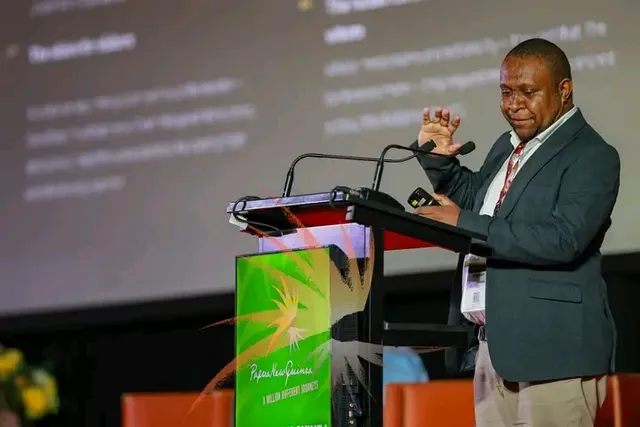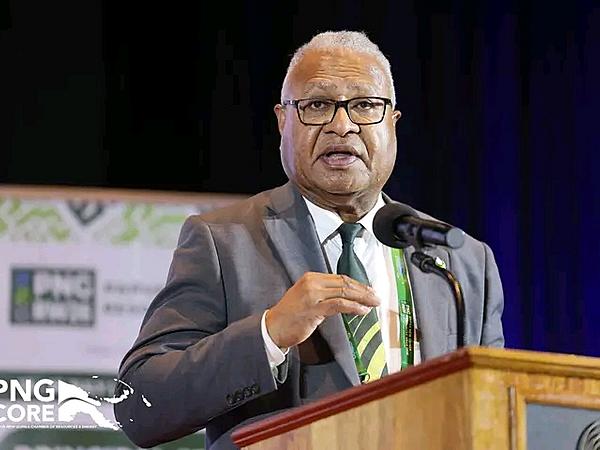
Papua New Guinea's financial sector must urgently bring an estimated K15 billion circulating outside the country's formal banking system into the economy if the nation is to fully capitalise on its growing resources and energy industry, TISA Group Chief Executive Officer Michael O. Koisen said.
Speaking during Day Three, Session 11A: Finance in Resources & Energy (FIRE) at PNG Resources Week 2026 on 15 July 2026 at APEC Haus in Port Moresby, Koisen said finance must become the engine that transforms temporary resource revenues into long-term, inclusive economic development.
He said PNG's expanding energy and mining sectors present significant opportunities, but the country's financial institutions must evolve to ensure more Papua New Guineans benefit from the wealth generated by major resource projects.
Global investment trends are increasingly being shaped by environmental, social and governance (ESG) standards, with international lenders and investors assessing projects not only on financial returns but also on sustainability outcomes.
Koisen said green development should be viewed as a competitive advantage rather than a compliance burden, noting that projects incorporating climate resilience, community development and clean energy transition pathways are more likely to attract premium international financing.
He also highlighted the growing international expectation for greater localisation across the resources sector.
The traditional model, under which capital is raised offshore, resources are extracted and revenues remain overseas, is gradually being replaced by stronger requirements for local participation.
According to Koisen, governments, investors and markets now expect landowners, local contractors and small and medium-sized enterprises (SMEs) to play a greater role throughout the resource supply chain.
While major multinational resource companies have relatively easy access to international financing, he said PNG's greatest financing challenge lies with domestic businesses supporting those large-scale developments.
"The true commercial bottleneck in PNG lies in access to capital for the domestic supply chain," he said.
He said the greatest investment opportunities extend beyond extracting gas, gold and other minerals, with significant potential in downstream industries such as infrastructure, logistics, marine transport, heavy equipment leasing, engineering services and catering.
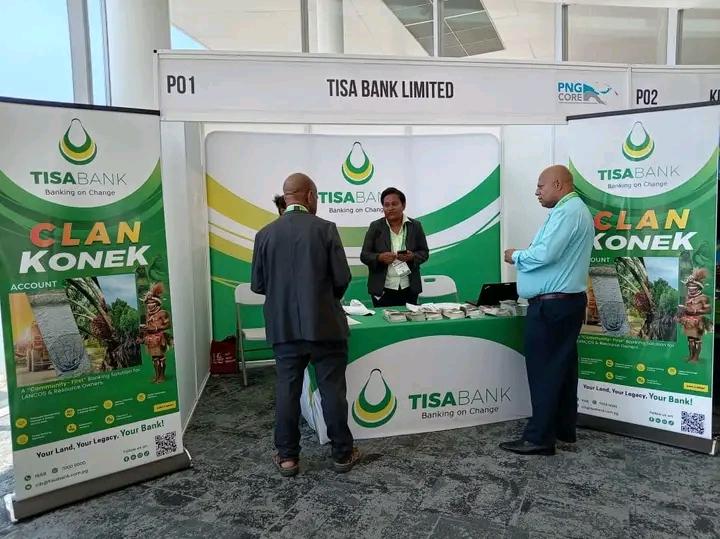
However, many locally owned businesses struggle to fulfil supply contracts because they cannot secure flexible working capital, trade finance or invoice discounting from financial institutions.
Koisen called on commercial banks to modernise their lending approaches by adopting more flexible financing models and digital credit assessment systems that enable local companies to participate meaningfully in major resource developments.
He said PNG businesses should become active participants in resource projects rather than spectators in their own country.
Addressing the challenge of avoiding the so-called "resource curse," Koisen outlined three critical priorities needed to convert finite resource wealth into sustainable national prosperity.
Foremost among them, he said, is capturing the estimated K15 billion currently circulating outside the formal financial system.
When royalties and wages from resource projects are paid to landowners, much of that money quickly flows into the informal economy, limiting its contribution to broader economic growth.
He proposed expanding digital financial infrastructure through low-bandwidth USSD platforms, mobile wallet technology and agency banking networks to connect rural communities directly with formal banking services.
Such systems would allow landowners to safely save, invest and grow their wealth while increasing the economic multiplier effect across the country.
Koisen also advocated integrating banking and insurance services into comprehensive financial products tailored to businesses operating in the resource sector.
Combining commercial lending with insurance would reduce operational risks for local contractors by protecting assets operating in high-risk resource environments, while improving business sustainability and reducing loan default risk.
Recognising that mineral and petroleum projects have finite lifespans, Mr Koisen said finance must ultimately redirect today's resource income into sectors capable of sustaining future generations.
He urged greater investment in climate-resilient agriculture, renewable and sustainable energy, and digital education to build a diversified economy beyond extractive industries.
"As we look ahead through 2026 and beyond, the mobilisation of finance for resources and energy development cannot simply be about fuelling extraction. It must be about fuelling transformation," Koisen said. "It is about ensuring that every project approved, every well drilled, and every ounce of gold mined directly translates into a stronger local SME, a more secure family bank account and a highly resilient green economy."