Great Pacific Gold Corp. has outlined an expanded exploration programme for the second half of 2026 at its flagship Wild Dog Project in Papua New Guinea, targeting a total of 13,000 metres of drilling as two diamond drill rigs continue to operate across key prospects within the project's 15-kilometre structural corridor.
The company said one rig is currently drilling at the Kavasuki prospect in the Main Zone, while a second rig is operating at Kasie Ridge in the North Zone. Exploration during the remainder of the year will focus on advancing priority targets across the project and developing additional prospects for future drilling.
At Kavasuki, drilling is aimed at testing the continuity and extension of known high-grade epithermal gold mineralisation. Holes KVH-01 to KVH-07 were completed along an east-west cross-section of a north-south trending epithermal vein, with assay results still pending for holes KVH-06 and KVH-07.
The company said holes KVH-08 and KVH-09 are step-out holes located approximately 250 to 300 metres north of the original drill section and are designed to test down-dip and horizontal continuity of mineralisation near a historic trench reported to have returned 28 metres grading 4.48 grams of gold per tonne.
Approximately 1,200 metres of a planned 1,950-metre drilling programme at Kavasuki has been completed. Assays for KVH-08 remain pending, while KVH-09 is currently being drilled.
Previously reported results from the current programme include 58.9 metres grading 2.43 g/t gold in hole KVH-01, including 4.6 metres grading 8.24 g/t gold, and 38.4 metres grading 2.17 g/t gold in hole KVH-03, including intervals grading 10.26 g/t gold and 15.78 g/t gold. Hole KVH-04 returned 59.9 metres grading 1.33 g/t gold, including 14 metres grading 2.61 g/t gold.
Meanwhile, the first drill hole ever completed at the Kasie Ridge prospect has confirmed the presence of a large sulphide-bearing hydrothermal system beneath the lithocap, according to the company.
Drill hole KAS-01 reached a depth of 593.5 metres and intersected increasing alteration intensity, sulphide abundance and structural complexity with depth. Great Pacific Gold reported crackle breccia, vuggy silica, anhydrite veining and sulphide flooding from 336 metres, while semi-massive pyrite was encountered from approximately 460 metres to the end of the hole.
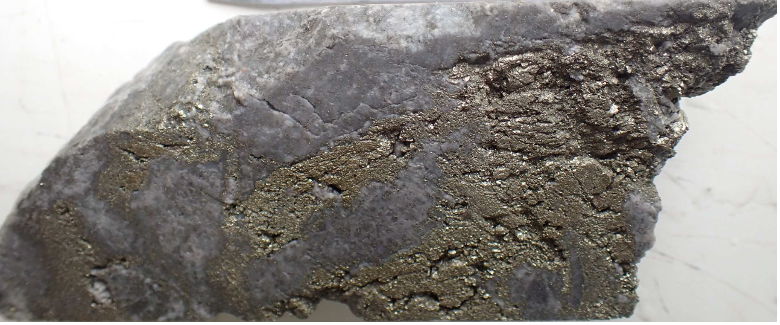
The company said the hole ended in strongly altered sulphide-bearing ground and did not reach the base of the sulphide system, indicating the hydrothermal system remains open at depth. Assays are pending from KAS-01, while samples have also been submitted for mineralogical studies, including X-ray diffraction analysis, to further characterise alteration mineral assemblages and assist in vectoring towards potential fluid pathways and the core of the system.
Vice President Exploration Callum Spink said the first Kasie Ridge drill hole had confirmed the presence of a large sulphide-bearing hydrothermal system beneath the lithocap, with alteration and sulphide intensity increasing with depth and remaining open at the end of the hole.
Following completion of the second drill hole at Kasie Ridge, the company's second-half 2026 drilling programme will focus on the 4.5-kilometre Main Zone, where approximately 8,000 metres of drilling are planned across the Kavasuki, Magiabe, Mengmut, Morgan and EK targets.
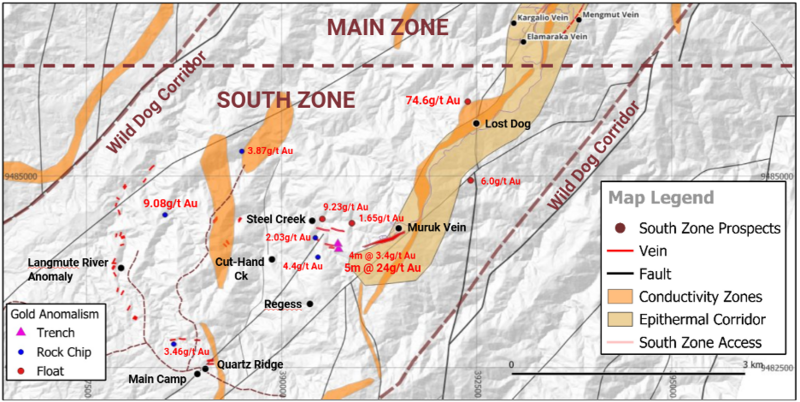
Beyond the current drilling campaign, Great Pacific Gold is advancing exploration in the South Zone, which the company describes as the next growth front for the project. The area hosts high-grade gold occurrences along five kilometres of largely unexplored epithermal vein structures that represent an extension of the Sinivit-Kavasuki Main Zone corridor.
Recent exploration results from the South Zone include a rock-chip sample from Steel Creek that returned 150 grams of silver per tonne and 0.13% copper, while a follow-up trench returned five metres grading 24 g/t gold. At the Lost Dog prospect, a rock-chip sample returned 74.6 g/t gold, while sampling at Quartz Ridge returned 3.46 g/t gold.
The company said its field exploration team will focus on prioritising and advancing eight South Zone prospects for potential drilling in 2027.
Spink said the company sees significant potential across the Wild Dog structural corridor as drilling continues at Kavasuki and multiple exploration targets advance through the project pipeline.
The Wild Dog Project is located on the island of New Britain and comprises a 15-kilometre structural corridor hosting multiple epithermal gold targets at various stages of exploration.