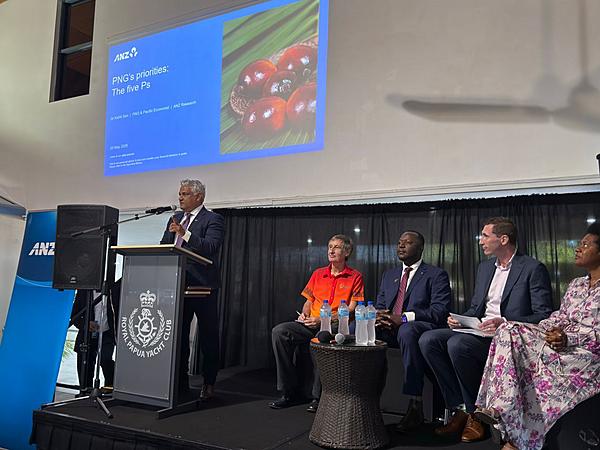
Questions surrounding the long-term sustainability of Papua New Guinea’s fuel stabilisation measures, the future direction of the kina, and the readiness of businesses to absorb rising costs dominated discussions during the Port Moresby Chamber of Commerce and Industry (POMCCI) breakfast meeting held on Wednesday, May 20, at the Royal Papua Yacht Club in Port Moresby.
The discussion followed presentations on Papua New Guinea’s economic outlook by ANZ PNG & Pacific Economist Dr Kishti Sen, alongside a high-level panel discussion involving Deloitte PNG Managing Partner Herbert Maguma, ANZ PNG Country Head Andrew Betteridge, POMCCI President Rio Fiocco, and Dentons Partner Wavie Leki. Discussions focused more directly on concerns raised by business leaders and participants attending the event.
Dr Sen and Mr Maguma responded to a range of questions relating to inflationary pressures, government intervention measures, foreign reserves, consumer behaviour and opportunities linked to major upcoming projects.
Fuel subsidy measures under scrutiny
Responding to questions about the government’s fuel stabilisation package, Dr Sen said authorities had little choice but to intervene quickly because of the immediate impact rising fuel costs would have had on transport operators and households.
He emphasised that many public transport operators could not instantly adjust fares to match higher operating costs, creating additional pressure on consumers and businesses alike.
Dr Sen said the combination of fiscal support measures and monetary policy options gave Papua New Guinea greater room to manage short-term inflation risks than many other economies facing similar pressures.
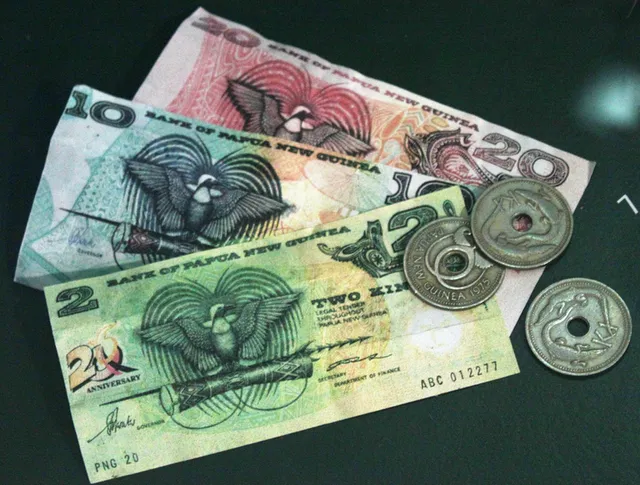
He argued that further depreciation of the kina during a period of elevated global inflation would worsen affordability pressures by increasing the cost of imported goods.
“Depreciating the kina further is just going to add to inflationary pressures,” he said during the session.
Instead, he suggested that maintaining exchange rate stability — and potentially allowing for a modest strengthening of the kina — could help reduce imported inflation, particularly for goods sourced from Australia and other international markets.
Foreign reserves remain strong
One of the key questions raised during the session centred on whether PNG had sufficient foreign reserves to maintain exchange rate stability amid continuing global inflationary pressures.
Dr Sen assured attendees that the country’s reserve position remained healthy.
“There’s plenty of reserves,” he said.
He explained that improving commodity prices and stronger foreign exchange inflows had significantly strengthened PNG’s external position, while turnover in the foreign exchange market had also improved.
According to Dr Sen, these conditions made it increasingly difficult to justify continued downward pressure on the kina.
Revenue collections supporting subsidy measures
Deloitte PNG Managing Partner Herbert Maguma provided further insight into how the government may be funding its current stabilisation measures.
Mr Maguma pointed to stronger-than-expected revenue collections by the Internal Revenue Commission and Customs, noting that both agencies had reportedly exceeded budget projections during the first quarter of the year.
He said improved collections had strengthened government revenues without the need for significant additional borrowing.
Mr Maguma also highlighted the government’s participation in petroleum investments through Kumul Petroleum Holdings, explaining that rising oil and LNG prices generate additional returns for the state through royalties and equity participation.
However, he acknowledged that questions remained over whether the current level of support could be sustained over an extended period if global volatility persists.
Businesses warned against panic buying
The Q&A session also explored how businesses and consumers may respond if uncertainty over fuel supply or pricing intensifies.
Drawing comparisons with behaviour observed during the COVID-19 pandemic, Mr Maguma warned that perceptions of scarcity could trigger panic buying and stockpiling.
He noted that concerns over possible fuel price increases had already led to longer queues at fuel stations over the previous weekend.
Businesses reliant on fuel for production, transport and energy generation may also attempt to increase fuel storage where financially possible, he said.
“If I was a business person and fuel was a key input into my operations, I would probably stockpile fuel if I had the capacity,” Mr Maguma said.
He warned that any future reduction in subsidy support would likely place additional pressure on operating costs across multiple sectors of the economy.
Major projects expected to drive economic activity
While much of the discussion focused on inflation and fuel-related pressures, panellists also highlighted several major projects expected to generate economic activity over the coming years.
Mr Maguma said the proposed Papua LNG project remained a significant opportunity for the economy, with ongoing discussions involving landowners and project stakeholders continuing ahead of a final investment decision.
He also pointed to construction activity linked to PNG’s future National Rugby League franchise, including new accommodation developments and plans for a Centre of Excellence near Santos National Football Stadium.
According to Mr Maguma, the sporting infrastructure projects are expected to create additional opportunities across construction, accommodation, tourism and hospitality.
He added that broader tourism opportunities linked to major sporting events could also support eco-tourism operators and small businesses across the country.
Throughout the discussion, speakers repeatedly stressed the importance of preparedness within the private sector. Businesses, industry leaders and investors were encouraged to strengthen operational planning, closely monitor input costs and prepare for potential volatility in fuel prices and broader inflation trends.
Despite ongoing global uncertainty, panellists maintained that PNG remained well-positioned for medium-term economic growth due to its strong resource pipeline, improving revenues and major infrastructure developments currently underway.