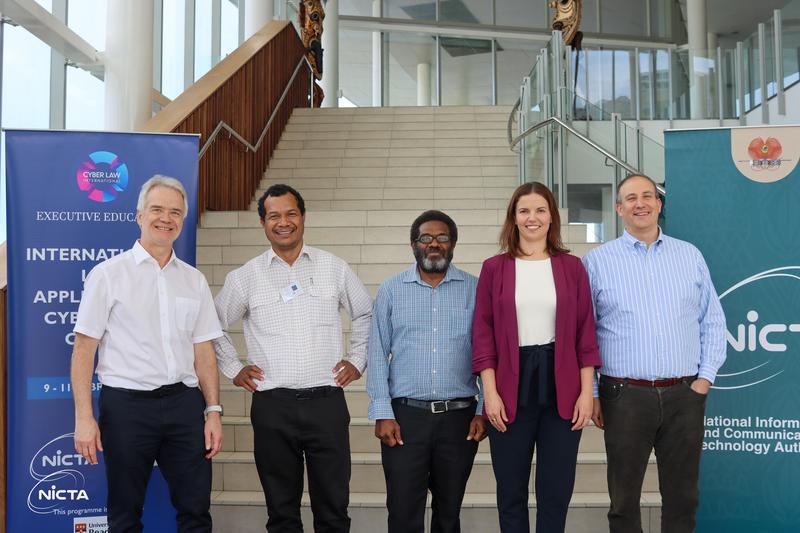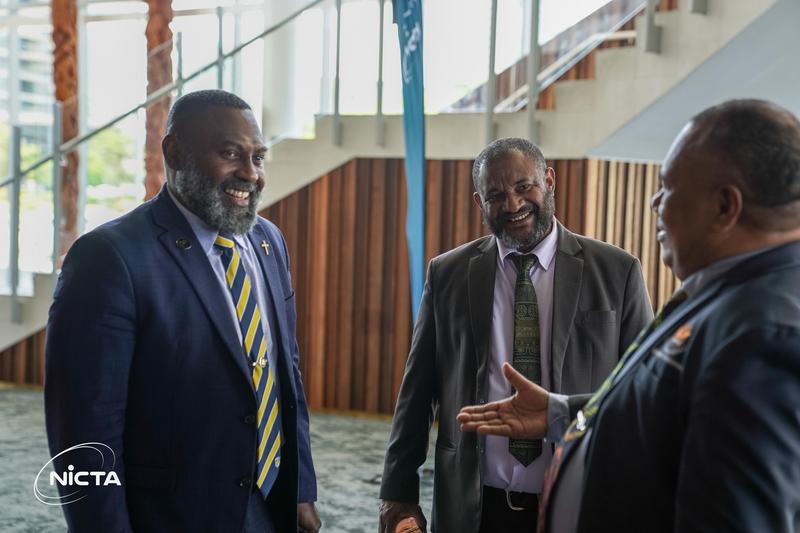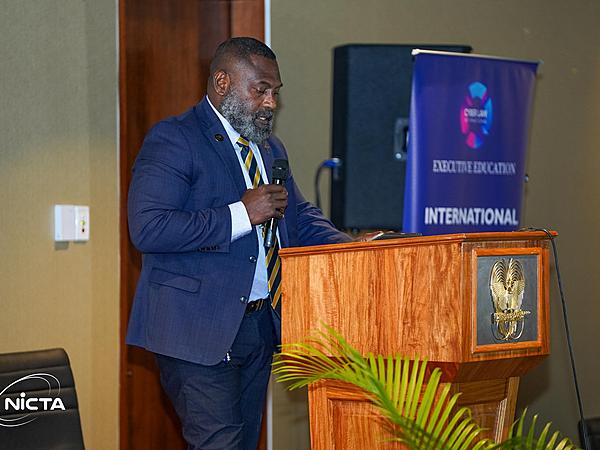
Acting Minister for Information and Communications Technology Peter Tsiamalili Jr. formally closed a week-long programme on international cyber law and cybercrime cooperation, calling it a pivotal step in Papua New Guinea’s digital development pathway.
The workshop, held at APEC Haus from 9 to 13 February, brought together government agencies, international experts, and partners to strengthen PNG’s national capability in cyberspace. In his closing remarks, Minister Tsiamalili emphasised that protecting essential systems, maintaining trust, and responding credibly to cyber incidents is now “mandatory, not optional” for the country.
“The Government is very clear on what it wants to achieve,” he said, reflecting on PNG’s realignment of priorities since its 50th anniversary last year. He noted that the ICT sector has become an integral part of every government function and operation.
Minister Tsiamalili highlighted PNG’s recent international commitments, including Parliament’s ratification of the Budapest Convention on Cybercrime in November 2025. He noted that the country is now set to deposit its instrument of accession. PNG also signed the Hanoi Convention, informally known as the United Nations Convention Against Cybercrime, in October 2025 in Hanoi, Viet Nam, and has taken deliberate steps to align national policies with trusted international frameworks.
“These actions reflect PNG’s intent to build a lawful, credible, and cooperative national posture, supported by real institutional capability,” Minister Tsiamalili said.
He underscored PNG’s regional leadership, citing the 2023 Lagatoi Declaration as evidence of Pacific Island Forum countries’ shared understanding that cooperation is essential to protecting citizens and growing digital economies. Accession to the Budapest Convention, he added, will strengthen collaboration with State Parties in the Pacific and globally on lawful data requests, timely assistance, and coordinated responses to cybercrime.
During the week-long programme, participants completed the course International Law Applicable in Cyberspace, which focused on implementing the Budapest Convention. International faculty from Cyber Law International, including Ms Liis Vihul, Professor Marko Milanovic, and Mr Alexander Seger, guided PNG officials through legal principles, enforcement realities, and cross-border cooperation.
Closing the programme, Minister Tsiamalili stressed immediate follow-through. “The task now is execution: coordinated institutions, clear mandates, lawful powers, safeguards that protect rights, and trained officers who can act quickly and correctly. Let us translate this week’s learning into a national work programme with clear responsibilities and timelines.”
He said PNG’s accession to the Budapest and Hanoi Conventions marks a major national step, aligning institutions with trusted international standards for tracking cybercrime and enabling lawful cooperation on electronic evidence.
The programme was co-organised by the Government of Papua New Guinea through NICTA and facilitated by the Australian Government through Australian AID.