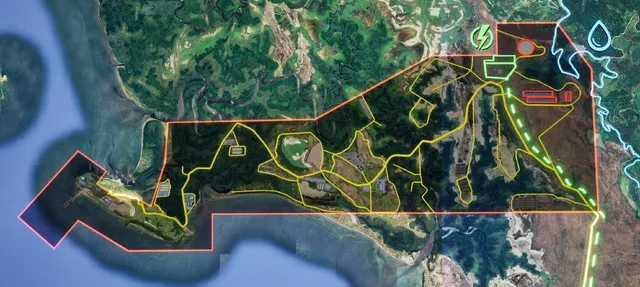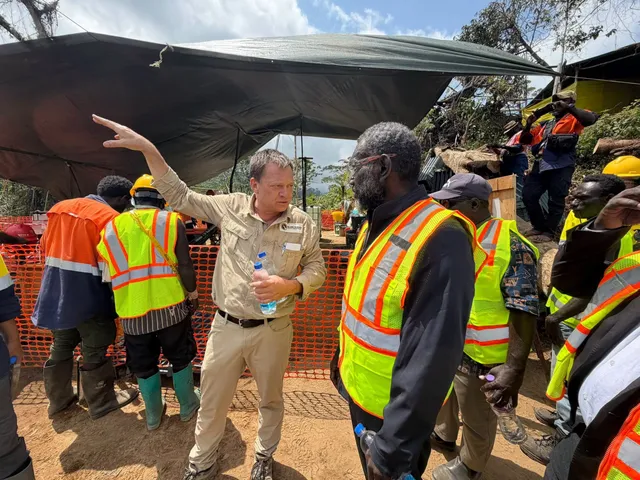
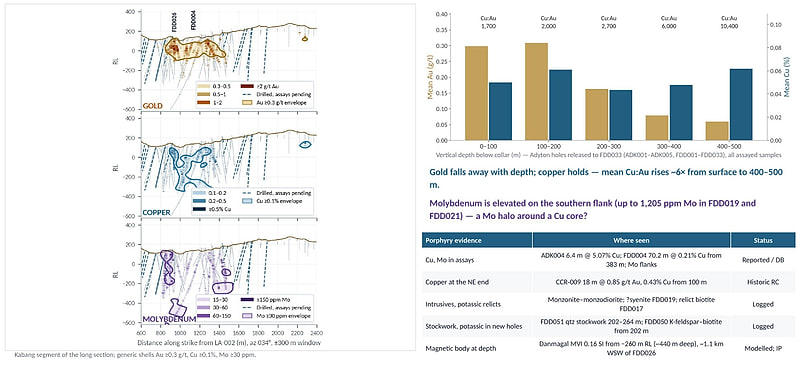
Adyton Resources Corporation has extended the mineralised corridor at its Feni gold-copper project in Papua New Guinea to about 2.2 kilometres, with drilling indicating stronger copper mineralisation at depth.
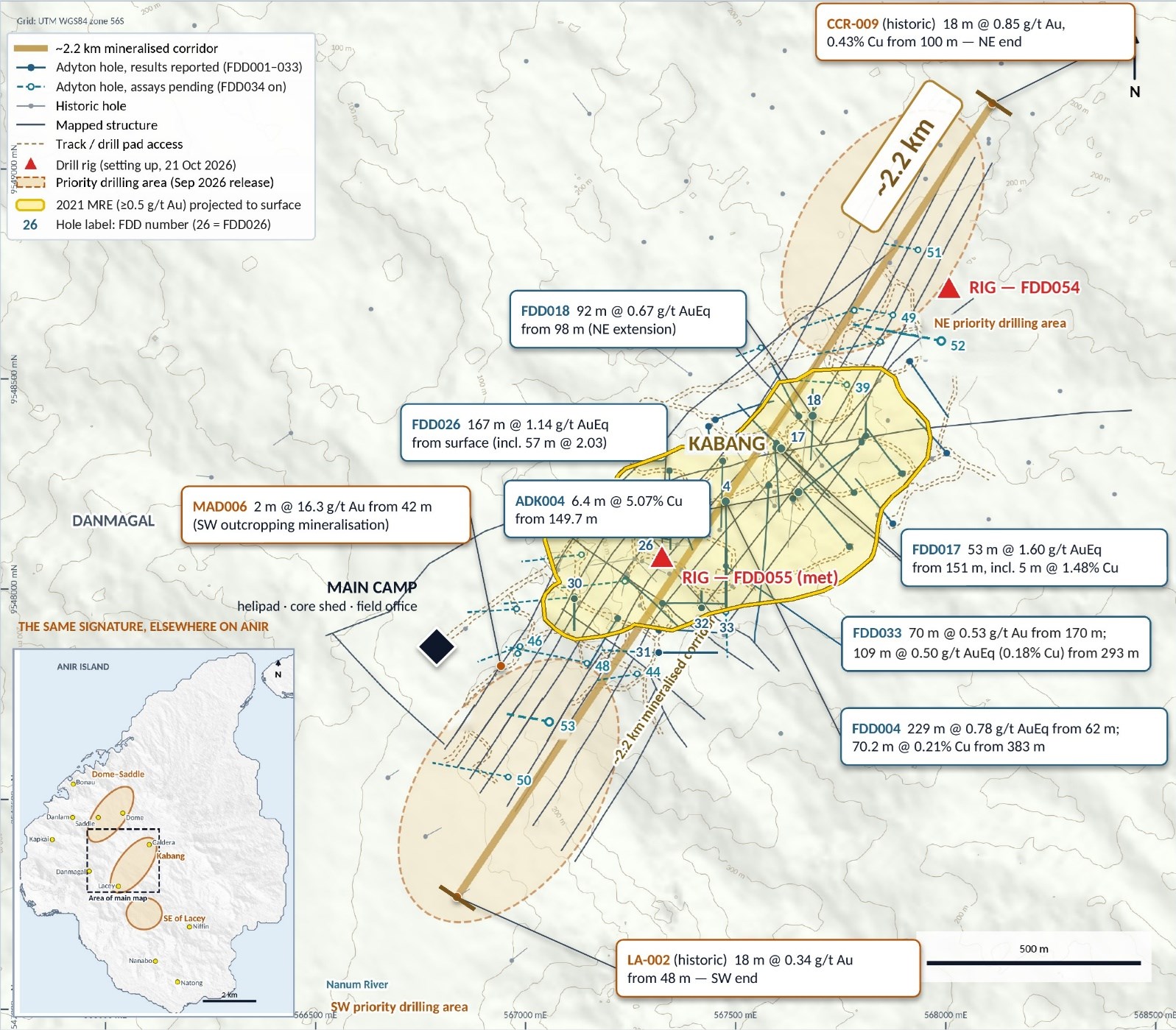
The company said in an exploration update on Oct. 23 that step-out drilling at the Kabang prospect on Anir Island had intersected geological structures and hydrothermal breccias at both ends of the corridor, expanding its potential beyond the area covered by a 2021 mineral resource estimate.
Adyton said drill holes FDD050 and FDD051, located towards the south-western and north-eastern ends of the corridor, were about 1.6km apart. Assay results from the expansion drilling were pending.
The company also reported copper and gold mineralisation in hole FDD033, which intersected 109 metres grading 0.25 grams per tonne of gold and 0.18% copper from a depth of 293 metres.
The interval included 20 metres grading 0.42% copper and 0.22g/t gold from 326 metres, supporting the company's assessment that copper mineralisation strengthens at depth.
Adyton said the findings added to evidence that Kabang could host a larger porphyry copper-gold system beneath its gold-dominant mineralisation. However, further drilling and analysis are needed to establish the extent and economic potential of the system.
The company also reported identifying bornite, a copper-bearing mineral, alongside chalcopyrite in potassic-altered quartz diorite in hole FDD033 between 392 and 400 metres.
Adyton interprets the Kabang deposit as a gold-dominant epithermal system overlying an earlier porphyry copper-gold-molybdenum system.
The company said its 100%-owned Feni project hosts an inferred mineral resource at Kabang of 60.4 million tonnes grading 0.75g/t gold, equivalent to 1.46 million ounces. The estimate is based on a technical report effective Oct. 14, 2021.
Adyton cautioned that the latest expansion holes had yet to receive assay results, with visual observations of mineralisation not necessarily indicating its grade or economic significance.
The company is preparing to complete the final two holes of its 2026 Phase 1 drilling programme. Hole FDD054 is intended to test the north-eastern corridor, while FDD055 will twin an earlier hole to obtain core for metallurgical testing and support a planned 2027 mineral resource estimate update.
The Phase 1 programme is scheduled to conclude in mid-to-late November, with assay results and further target development expected to guide the next stage of drilling.
Adyton is also conducting a 5km-by-5km induced polarisation survey across the project area, which was about 30% complete as of the latest update. Completion is expected around the end of January 2027.
The survey is intended to refine exploration targets across Feni, where the company has identified 12 known targets and 26 geophysical targets. Two prospects, Dome-Saddle and an area south-east of Lacey, have mineralisation and alteration signatures identified in historical data but have yet to be comprehensively tested by drilling.
At Danmagal, about 1.1km west-south-west of hole FDD026, surface mapping has identified porphyry-style intrusive rocks and alteration above a magnetic body modelled from a depth of about 440 metres. The potential source has not yet been drill-tested.
Adyton chief operating officer and chief geologist Chris Bowden said the extended corridor, increasing copper mineralisation at depth and additional untested targets supported further evaluation of the project's potential.
The Feni project lies along the Lihir geological trend in Papua New Guinea. Adyton said the next phase of drilling would be planned after the Phase 1 assays, induced polarisation survey results and metallurgical work were available and exploration targets had been ranked.