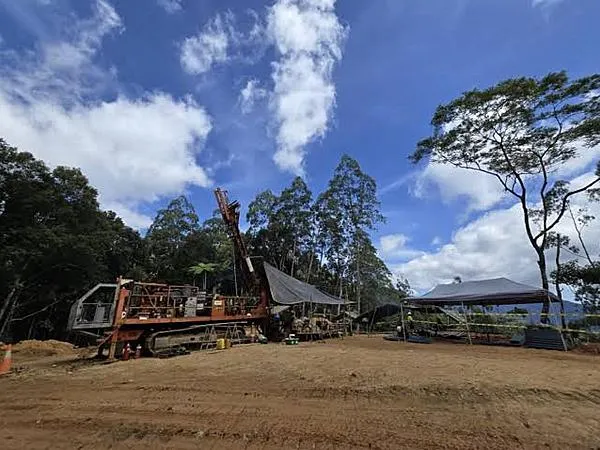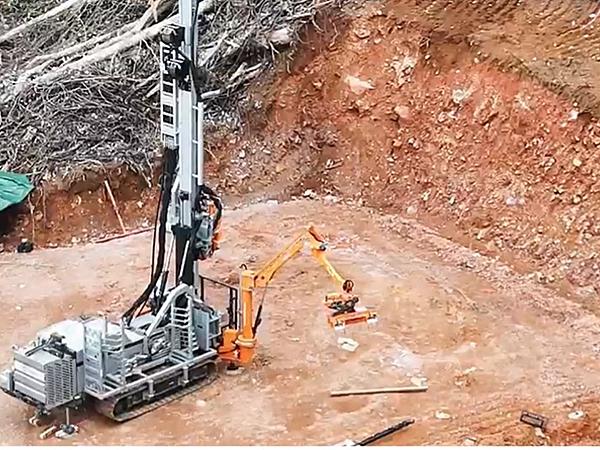
Great Pacific Gold Corp. has mobilised a second diamond drill rig to its flagship Wild Dog Project in Papua New Guinea, with drilling now under way at the Kasie Ridge epithermal gold-copper target.
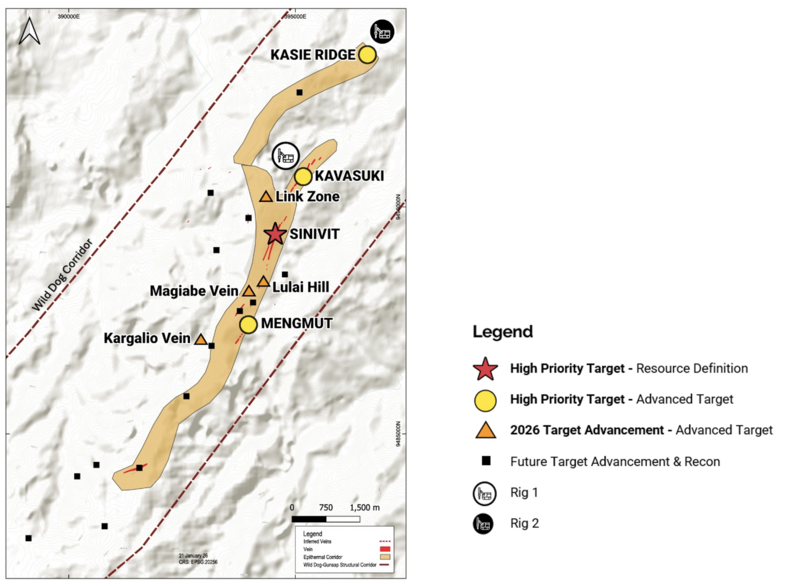
The Canadian-listed company said the second rig has commenced drilling at Kasie Ridge, marking the first drill programme ever undertaken at the prospect, located on the island of New Britain in East New Britain Province.
Kasie Ridge is described as the largest preserved advanced argillic alteration system identified so far within the Wild Dog Project. The prospect forms part of the broader Nengmutka hydrothermal system and lies northeast of the central Wild Dog structural corridor.
The company said geological interpretation suggests Kasie Ridge represents a structurally controlled lithocap developed above, or adjacent to, a potential high-sulphidation epithermal or porphyry system at depth. The alteration footprint extends about 1.5 to 2 kilometres along strike and spans several hundred metres in width.
The alteration assemblage includes pyrophyllite, dickite, kaolinite, alunite, diaspore and zunyite — minerals typically associated with high-temperature, acidic hydrothermal conditions. The presence of zunyite and diaspore is considered significant, as both are commonly linked to higher-temperature environments proximal to a heat source.
“Kasie Ridge is a very technically compelling target on the Wild Dog project,” said Callum Spink, vice president for exploration.
“Drilling with Rig 1 is also progressing well with a second hole underway at the Kavasuki target. Having two rigs turning full time will allow us to increase the pace of our exploration in 2026, as planned,” Ridge added.
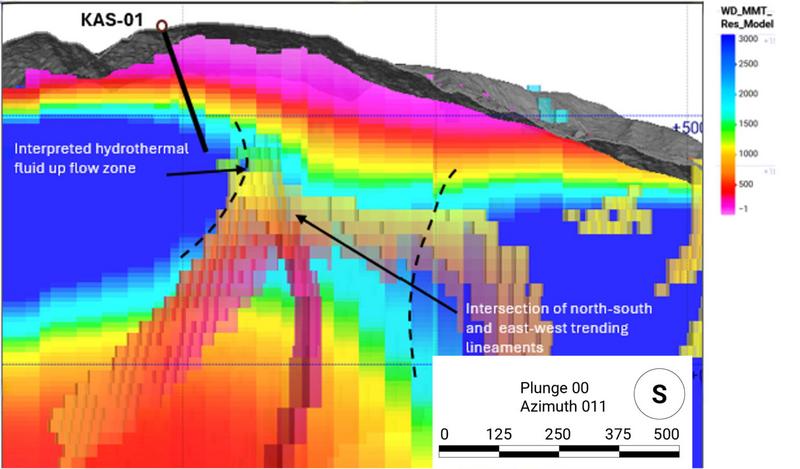
Structural analysis highlights multiple north-northwest to northwest trending lineaments converging beneath Kasie Ridge, a geometry consistent with focused hydrothermal fluid pathways in mineralised systems.
The first drill hole, designated KAS-01, has been collared within the highest-temperature portion of the advanced argillic assemblage. It is designed to test the interpreted intersection of two conductive lineaments, evaluate the margin of a moderately conductive upflow zone defined by resistivity inversion modelling, and assess vertical alteration zonation and sulphide development at depth.
Great Pacific Gold said results from KAS-01 will determine follow-up drilling and whether the prospect advances to more systematic testing.
Drilling continues simultaneously at the Kavasuki target within the Wild Dog corridor, where a second hole is under way using the first rig. The deployment of two rigs is expected to increase the pace of exploration in 2026.
The company noted that lithocap systems are inherently high-risk, as advanced argillic alteration may occur without associated economic mineralisation at depth. However, alteration systems of this scale require sustained hydrothermal fluid flow and structural permeability, features commonly associated with mineralised magmatic centres.
Comparable geological settings cited for context include Lepanto in the Philippines, Wafi-Golpu in Papua New Guinea and Onto in Indonesia, where lithocap alteration overlies deeper porphyry or high-sulphidation mineralisation.
Kasie Ridge lies at the northern end of the 15-kilometre Wild Dog structural corridor, about 4.5 kilometres north of the Sinivit target, where previous drilling delineated multiple high-grade shoots.
The company’s working interpretation considers Kasie Ridge to represent the preserved upper levels of a high-sulphidation epithermal system or lithocap developed above a potential porphyry source, with mineralisation possibly occurring beneath or laterally offset from the alteration cap.