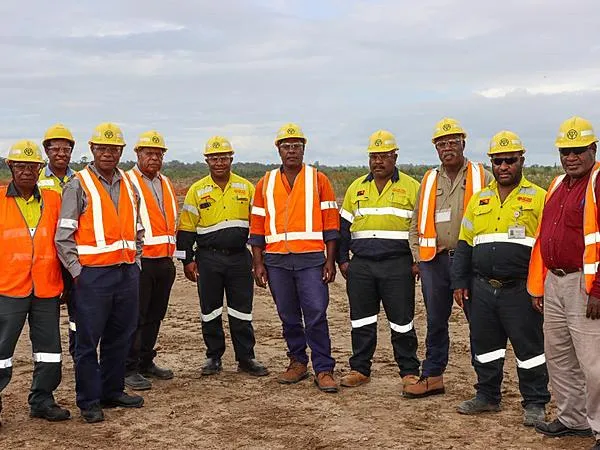
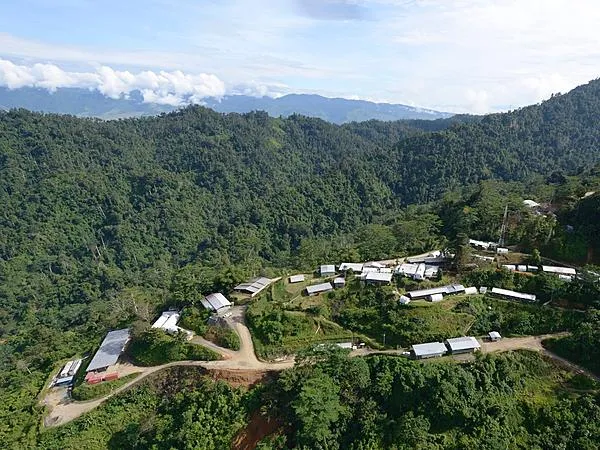
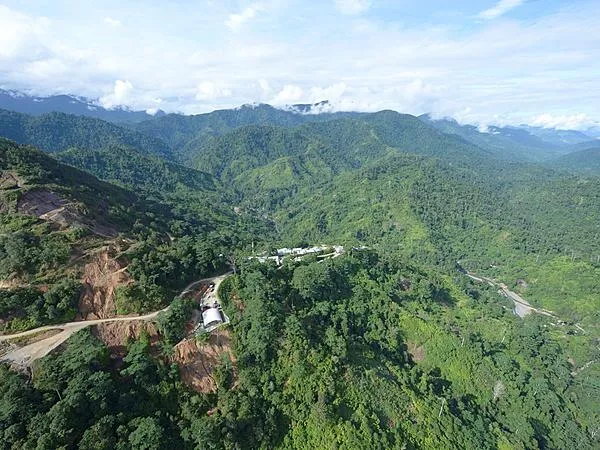
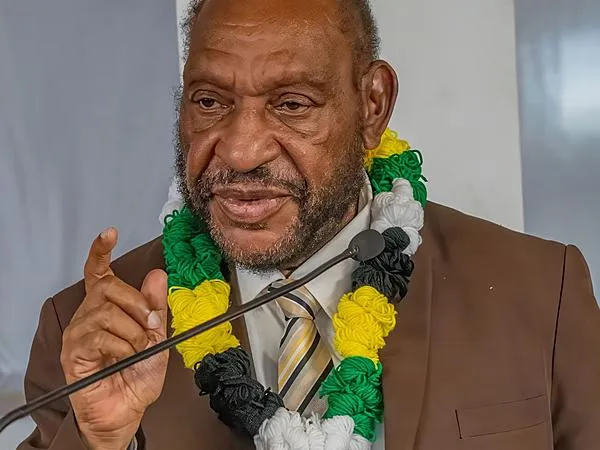
Tolu Minerals has launched the Bakoiudu-Tolukuma Road Project in Central Province, Papua New Guinea. This crucial infrastructure initiative will connect the Kairuku and Goilala Districts, benefiting both the Tolukuma Mine and local communities.
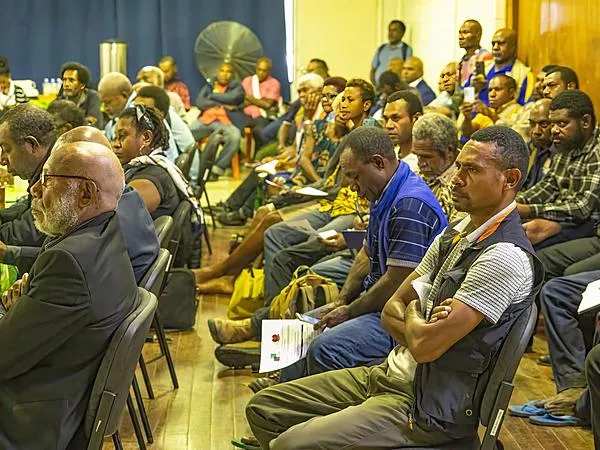
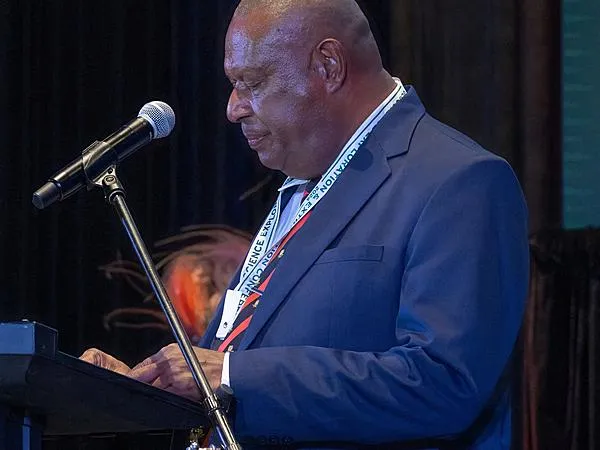
Governor for Central Province, Hon. Rufina Peter, and Managing Director of the MRA, Mr. Jerry Garry, the Managing Director of Tunnel Engineering Ltd Allan Guo, and members of both the Kairuku and Goilala Districts attended the event along with local leaders, media representatives, and residents from both LLGs.
A Collaborative Effort
The project is a joint venture between Tolu Minerals, the Mineral Resources Authority (MRA), and various government bodies and local stakeholders. It has received strong support from the Central Province Government, Kairuku and Goilala Districts, and local leaders.
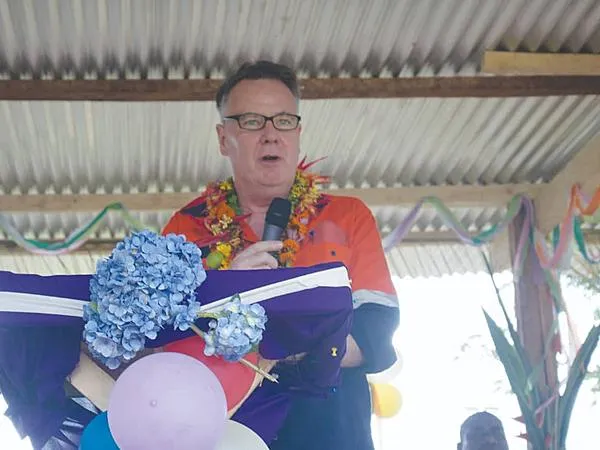
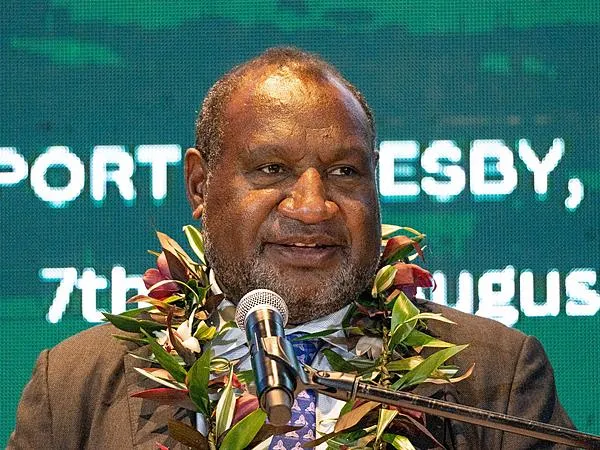
Chief Executive Officer & Managing Director of Tolu Minerals Ltd, Iain Macpherson’s keynote address, highlighted the transformative potential of the road project, not just for the Tolukuma Mine but for the entire Central Province. “Physical infrastructure always supports economic development,” he stated.
“Roads, in particular, allow sustainable business operations, promote the exchange of goods and services, facilitate the movement of people and skills, and generally enhance economic activity. The mere fact that a road is going through is going to change the nature of the region. It’s going to make it of more interest to people coming in from outside.”
Transforming the Region
The road will significantly improve access to the Tolukuma Mine, reducing reliance on costly helicopter transport. It will also boost economic activity in the region, creating jobs and facilitating trade.
“The road has to be built for the future of the mine and for the future of the region,” Macpherson remarked.
Hon. Rufina Peter said, “This road has been here for a long time. We have to make use of it.”
“Today, it is a new initiative we came together to launch. The power to change our lives and livelihood is in our own hands, individually. We can’t sit and wait, watch the opportunity to pass us. It’s a good opportunity that this developers have come to develop our district. Let’s take it,” she added.
Two-Stage Construction
The project is divided into two phases:
“My objective is to have the first vehicle drive that road well before the end of this year,” Macpherson declared.
“Thank you for your support in the past, today, and in the future to get this project completed. For the benefit, not only of Tolu Minerals and Tolukuma Mine, but for the communities and the district and the region as a whole. And indeed, for the benefit of Papua New Guinea as a whole.”
Economic and Social Benefits
The road will:
“With the right team, the right contractors, the right technology, I believe our plans to build and develop the regions will be successful.” Garry added.
A Catalyst for Development
The Bakoiudu-Tolukuma Road Project is a testament to the positive impact that responsible mining can have on local communities. It demonstrates Tolu Minerals' commitment to sustainable development and its role in driving progress in Papua New Guinea.
"The successful completion of the road will not only rejuvenate the Tolukuma Mine but also provide long-term economic benefits to the region, including employment opportunities and increased access to markets,” Macpherson said.
He reiterated, "We are absolutely committed to delivering this project and delivering the return of Tolukuma Mine and delivering the economic development of the entire region."
The PNG Extractive Industries Transparency Initiative (PNGEITI) has called on companies operating in the extractive sector to honour their commitments to the EITI process by being transparent in all areas of their operations, including their obligation to pay taxes to the government.
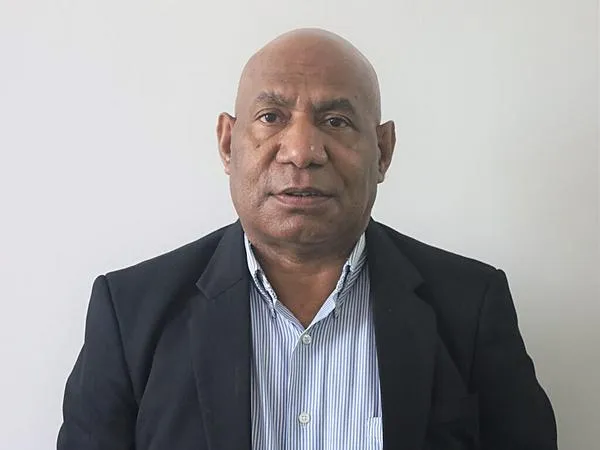
The Executive Director of the PNGEITI National Secretariat, Lucas Alkan, said these companies made their commitments to the EITI reporting framework when they signed up to support the government in implementing the EITI Global Best Practice Standard in 2013.
The call by PNGEITI follows concerns raised by the Internal Revenue Commission (IRC) last month that leading mining companies are not complying with their mandatory obligation to pay Dividend Withholding Tax (DWT). The IRC emphasised that a lack of DWT payments implied that these companies were either not generating adequate profits or were simply avoiding their tax obligations, thus depriving the government of much-needed revenue. The IRC stated that the payment of these taxes not only upholds fair tax practices but also supports the national economy and the government’s revenue.
The IRC Commissioner General indicated that despite a significant increase from K9 billion in 2013 to K44.2 billion in 2021, as reported by the Bank of PNG in its Quarterly Economic Bulletin (QEB), there have been no corresponding dividend payments to the stakeholders from these resource companies.
The President of the PNG Chamber of Resources and Energy (PNGCORE), in a media statement, explained that companies in the resources sector were reinvesting their profits back into the country. He emphasised that all existing projects have dedicated significant capital to mine expansion and development projects.
The Executive Director of the PNGEITI stated that while extractive sector resource companies may be reinvesting in expansions and capital expenditures as stated by PNGCORE, they must provide actual figures to justify this in the EITI annual reports as members of the EITI.
“Reinvesting in expansions among other capital expenditures is good for the economy, and the PNGEITI supports what they are doing, but this must be justified by providing actual data or figures on such expenditures in the EITI reports for transparency purposes,” said Mr Alkan. “I’m calling on resource companies to disclose to the public the actual figures expended on reinvesting in expansions and capital expenditures, as these alone will justify their stance,” he added.
The call for transparency and accountability in PNG’s extractive sector is not just about compliance but also has broader implications for good governance, social equity, and sustainable development in the country.
Mr Alkan added that enhanced transparency can lead to better resource management, build trust among different stakeholders, and contribute to long-term development goals.
He said these companies signed the Multi-Stakeholder Group (MSG) Memorandum of Understanding (MoU) in 2013 to be transparent in their operations through the EITI reporting process and must always demonstrate that they are honouring their commitments.
The PNGEITI reports are considered reliable and comprehensible sources of information aimed at increasing industry transparency and accountability. This is because the reports are prepared by independent administrators in accordance with the requirements of the EITI Standard.
The extractive sector contributes significantly to the economy, both directly and indirectly, in terms of government revenues and its contribution to GDP, while also delivering a range of socio-economic benefits. The revenue streams deemed material for EITI reports include those that contribute 2% or more of the total known revenue received by the government from the mining and petroleum sectors for that financial year. Revenue streams that are not considered material for reconciliation are reported unilaterally by the receiving government entity, or, in the case of social expenditures, by the companies making the payments.
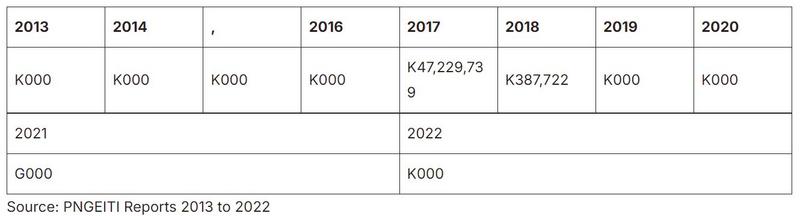
According to PNGEITI reports, the Dividend Withholding Tax payments received from 2013 to 2021 were considered not material for reporting. This meant that government revenue from DWT was consistently under 2% of total receipts annually. For instance, in the 2017 and 2018 PNGEITI reports, K47,229,739 and K387,722 were received, respectively, as DWT payments.
Mr Alkan noted that from January 2017, a standardised DWT rate across all sectors of 15% came into effect. Prior to this, withholding taxes had been concessional for resource taxpayers, with the DWT rate being nil for dividends paid out of gas or petroleum income and 10% for dividends paid by companies engaged in mining operations.
Taxation amendments introduced in the 2018 and 2019 Budgets exempted PNG LNG-sourced profits from paying dividends, consistent with the PNG LNG Gas Agreement, which also contributed to low DWT revenue to the government from 2018 to 2022.
The table below provides a summary of DWT received by the government from the years 2013 to 2022 as contained in the PNGEITI reports that have been published over these years.
Ok Tedi Mining Limited (OTML) hosted a delegation from the East Sepik Provincial Administration on a fact-finding mission to gain insights from the Ok Tedi operations to prepare for the upcoming Frieda River Project in the Sepik Region.
The delegation from the Provincial Administration Mining Desk Team, visited from the 11th – 16th August, to understand the various aspects of the mine operations to address some of their concerns with the upcoming Frieda River Copper-Gold Project.
The Frieda River Project is located in a region shared by both East and West Sepik Provinces, and has garnered significant attention from local communities due to its potential impact on the environment, particularly concerning the Sepik River and its floodplain system.
The delegation visited the Mine, Mill, Ok Menga Hydro Power Station, Bige and Kiunga Operations, and had the opportunity to witness the second stage of regional meetings for the current Community Mine Continuation Agreement (CMCA) Review.
They observed the management of mine waste, pyrite concentrate plant, environment monitoring, community relations activities, national and local content business structure, and community development programs, particularly through the Ok Tedi Development Foundation (OTDF).
Team Lead Mr Martin Torovi said Ok Tedi is of a similar physical setting to the proposed Frieda River Mine and the legacy issues of Ok Tedi are the very concerns and anxiety of the Sepik River People.
“If Environmental Permit is granted, East Sepik Provincial Administration will be tasked with managing a large mine’s environmental “impact” and benefit sharing agreements and negotiations. We Sepiks do not have the experience to manage these issues. As such we reached out to Ok Tedi for the learning experience,” said Mr Torovi.
“Some of the key takeaways from the visit include: The Development of Engineered Waste Rock Dumps; pyrite treatment plant; Bige Dredging; sustainable development projects; and understanding the Equity, Royalty, Trusts and Development Funds structure.”
Mr Torovi added, “We also could not have asked for a better time to conduct this visit. We had the opportunity to observe the CMCA meetings that is very appropriate to the concerns we have.”
Provincial Mine and Lands Minister & President of Gaui LLG Mr Leo Singut said he was appreciative of the opportunity to visit and learn from Ok Tedi.
OTML Managing Director and Chief Executive Officer, Kedi Ilimbit, said “We are pleased to provide the delegation valuable insight into the multifaceted activities of our operation. We believe the visit has provided them valuable information as they prepare for the upcoming Frieda River Project and its impacts in their respective region and province.
A state team recently conducted a pre-Community Development Agreement (CDA) awareness program in Lae, involving parties to the Wafi Golpu mining project CDA.
The parties are Yanta, Hengambu, Babuaf, Wampar, Butibam, Wagang, Morobe Provincial Government and host Local Level Governments.
The consultation program was aimed at educating the parties who are landowners, impacted communities and stakeholders of the project, on the various benefit streams that will be available to them and how the CDA process will go.
The benefit streams include royalties, equity, Business Development Grants, Infrastructure Development Grants and Tax Credit Schemes amongst others.
The state team explained the various laws, policies and processes, governing the distribution of benefits, and who the beneficiaries of the CDA are going to be.
The highlights of the team's presentations were the explanation on what CDA is and its processes, equity break- ups and business spin -off opportunities that will be available to the landowners and stakeholders.
The landowners and stakeholders asked questions regarding the different agendas that were presented by the State Team, which the team explained.
John Nema, President of Hengambu Landowners Association, thanked the state team for sharing vital information on benefits. Hengambu is one of the three Special Mining Lease (SML) 10 landowner groups, that will benefit from Wafi Golpu Project. The other two are Yanta and Babuaf.
Mr Nema said his group wanted the project to commence immediately. However, he said they needed more information to prepare well for the CDA proper.
He said: “Our people fully support the project. We are willing to sacrifice our land and move this project forward,” said Mr Nema. He urged all landowner groups and stakeholders to cooperate with the state team inspite of their differences in opinions, so that the CDA could be signed in a timely manner.
The State Team said they were going to share more information and that this was the first of more meetings to come. Officer-In-Charge (OIC) of the Mineral Resources Authority’s (MRA) Development Coordination Division (DCD), Jerry Naime, said the state team would put together a road-map going forward for all parties to follow, with the focus to successfully completing the CDA.
The State Team was led by the Department of Prime Minister and National Executive Council (PM & NEC). Other departments represented were the Office of the State Solicitor, Mineral Policy & Geohazards Management (DMPGM), Commerce & Industry, Treasury and the Mineral Resources Authority (MRA).
Mayur Resources is pleased to provide an update on Stage 2 wharf development at the Central Cement and Lime Project in Papua New Guinea.
Mayur Resources Managing Director Paul Mulder said the wharf development was a critical piece of work enabling marine infrastructure for both PNG, and the Company’s future plans.
“Dedicated wharf facilities are strategically important to Mayur’s CCL Project. The proximity of the wharf is less than one kilometre from Mayur’s manufacturing facilities and quarries. This compares incredibly favourably over some of our Southeast Asian competitor suppliers, who have trucking distances of some 100 kilometres to the wharf prior to barging to the FOB loading point that are significantly further away from customer markets in Australia and the Pacific, both of which, generate a significant cost advantage for Mayur
“Our wharf facilities create a unique, vertically integrated development with a highly efficient supply chain and direct access to Southeast Asian markets. We look forward to completing construction in Q4 CY2024 and generating earlystage revenue from the sale of limestone and aggregates,” Mr Mulder said.
Second Stage of Wharf Construction Commences
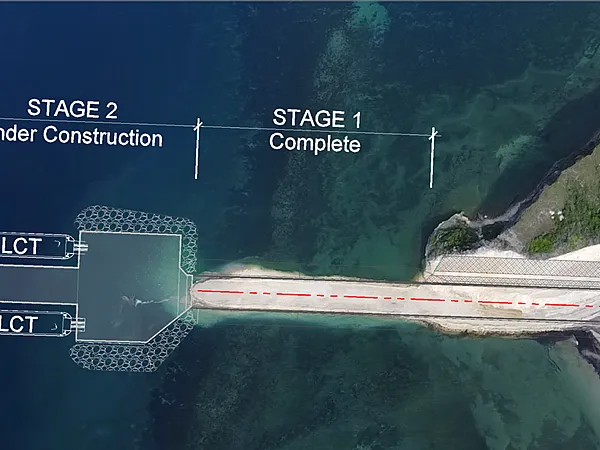
Mayur has placed key orders for construction materials i.e. sheet piling for Stage 2 construction of the wharf with PNG owned and operated Hi-Lift Global, a company with over 48 years of experience in PNG in logistics and facilitating the delivery of construction materials. This is a key milestone in the Company’s CCL project construction program, with the wharf development scheduled to be completed by Q4 CY2024.
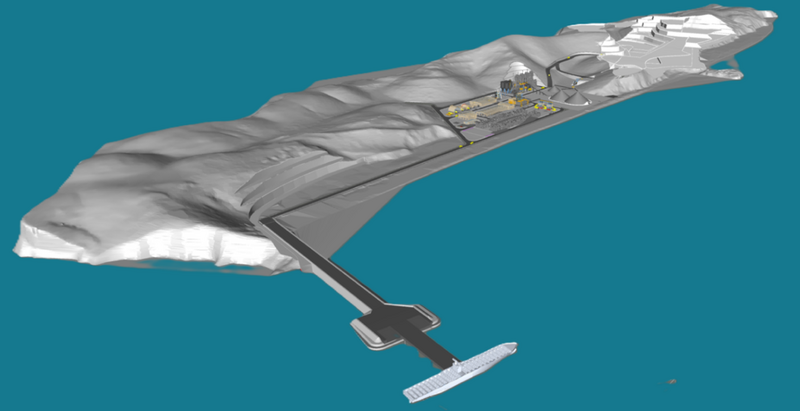
Stage 2 of the wharf (Figure 2) will enable both roll-on/roll-off barge access and crane loaded double sided barge operations. First revenues from the sale of limestone and aggregates are expected once Stage 2 of the wharf completes later this year.
Stage 3 of the wharf development is planned for 2025. Once completed, the wharf will be capable of loading and unloading bulk materials on vessels up to Handymax size (40,000 to 55,000 tonnes).
Mayur will own the wharf, which is a strategic asset for the Company’s CCL project. It will provide the Company with ownership and control of its supply chain within PNG, while also providing access to both domestic and export markets. The Company will also continue engagement with other third party prospective Port Operators and Owners.
PNG establishes State Negotiation Team engagement to facilitate Central Lime and Cement Project
Mayur is pleased to report that the National Executive Council of Papua New Guinea’s Government has established a State Negotiation Team to finalise the terms of a Project Development Agreement (the PDA) between Mayur and the PNG Government. The PDA will set out the terms upon which the PNG Government will participate in the CCL Project, ensuring the interests of the state, provincial government, and landowners are adequately represented.
Finalising a PDA with the PNG Government is a critical final step towards Mayur commencing full scale construction of the Central Lime Project and the later expansion into Clinker and Cement.
Mayur expects to finalise the PDA within Q3 CY2024.
Ongoing Stakeholder Engagement & Community Benefits
Mayur is soon to commence construction of a new rugby and sports field for the local community in Kido. Design works are complete with construction to commence in parallel with Stage 2 development of the wharf.
The sports field is critical social infrastructure for the Kido community and early construction will allow for a transition from the existing field to a new location by the end of Q4 CY2024.
Infrastructure projects that will benefit the Kido community will commence upon Financial Investment Decision Conditions Precedent being achieved for the Central Lime Project financing. These include but not limited to the provision of water and electricity supply infrastructure and connecting road and bridge access to Port Moresby.
The Autonomous Bougainville Government (ABG), Bougainville Copper Limited (BCL), and Rio Tinto have signed a Memorandum of Understanding to address concerns around future risks of ageing infrastructure in the former Panguna mine area.
This collaboration comes in response to information obtained during field work forthe independent Legacy Impact Assessment, which identified several ageing structures requiring prompt attention. The MoU aims to mitigate potential risks associated with deteriorating infrastructure and promote safety in the region.
Works will be carried out on old BCL assets, including the Jaba Pump Station and the Momau River Bridge, as well as the former mine area workshop, storage facilities and concrete wall in the Panguna town area. The works are expected to commence in November 2024 and will take several months to complete.
ABG Chief Secretary Kearnneth Nanei said concerns about run down infrastructure had been escalated to the government following field work conducted as part of the Panguna Mine Legacy Impact Assessment (PMLIA).
“We are very pleased to be working with BCL with support from Rio Tinto in responding to the issues raised, in the best interest of our people. As we await the final results of the legacy impact assessment, these works represent a positive sign of cooperation by BCL and Rio Tinto,” he said.
BCL Chairman Sir Mel Togolo said as the mine’s former operator and holder of the EL01 exploration licence for the area, BCL maintains a presence and is recognised as a development partner on the ground in Bougainville.
“Our local team will be working closely together with the ABG in overseeing the project works to ensure these ageing buildings and structures don’t cause issues for the community,” he said.
Rio Tinto Country Director for PNG Andrew Cooper said: "We are pleased tosupport the Autonomous Bougainville Government and Bougainville Copper Limited in addressing these issuesidentified as a priority during the legacy impact assessment field work. We commend the ABG and Chief Secretary Nanei for their proactive leadership in driving tangible action.”
The results of Phase 1 of the PMLIA are due for public release in the fourth quarter of 2024. These will provide all parties with a clearer understanding of the potential environmental impacts and directly connected social and human rights impacts, associated with the Panguna mine since the cessation of mining in 1989.
PNG has and estimated 100 (m) million ounces of gold that is yet to be mined according to the Prime Minister Hon James Marape.
The PM revealed this when officially closing the Geoscience, Exploration & Extraction Conference 2024 yesterday at the APEC Haus in Port Moresby.
He said based on the gold price of around US$ 2,400, the 100m ounces would equate to a total asset base of US$150 billion worth of gold. He described the numbers as “staggering” considering that PNG also produces copper, nickel and silver which adds onto the asset base.
He said PNG has a young geology and that the country sits on possibly six or seven plate tectonics that is still forming, with mineralization continuously taking place.
The PM said in terms of policy, the government was looking at ensuring that PNG harvests and processes its resources in the country, so that the nation value-adds and exports finished products.
“Our market is closer to home, not to mention markets further from us. We have 4 billion people right within the Asian region and millions in Australia with appetite for our resources. We are placed in a in a part of planet Earth that can produce resources, process resources and supply to the market that is closer to home.”
He assured the mining sector that it would continue to receive government support, adding that the government was looking at regulatory framework and legislative environment that does not hurt investors, but at the same time PNG value-adds from the harvest of its resources.
The PM said that the government was looking at a transparent way of farming out exploration and ensuring that the best companies are participating in exploration, and development of our resources. He said the Department of Mineral Policy & Geohazards Management (DMPGM) and the MRA have been asked to look at the the possibility of auctioning resources . He said this was something that the government was looking at very closely.
“We put the resources, maps and exploration spaces on auction. The best companies out there who have cleaner technology, better resource benefit sharing formula and those who can respect my Land owners and provinces better, could come in, bid and bring in the capital and work with local partners to develop these resources.”
There has been a decline in mineral exploration activities in the country since 2019, according to the Managing Director of the Mineral Resources Authority (MRA), Jerry Garry.
Mr Garry said this recently at the Geoscience, Exploration & Extraction Conference 2024, at the APEC Haus in Port Moresby.
The MD said from 2012-2018, most of the country was taken up by companies exploring for mineral resources. He said today exploration activity had declined significantly, indicating that it was a concern.
“As a country, without exploration, there will be no mining,” said Mr Garry.
He said some of the factors that had contributed to the decline had been the negative perception about the country especially in terms of law & order, lack of geoscience data and the perception that the turn-around time for permitting of licenses is slow amongst other factors.
About 60% percent of the country’s annual revenue comes from the mining sector. It is therefore important to start looking for new mines now, because the lead time from discovery to commissioning of projects is between 11-50 years, as in the case of the Frieda River Project. The MD said the Frieda River project was discovered in 1967 and that the project had not been commissioned yet.
Mr Garry said in order to overcome the challenge of depleting resources, the MRA had come up with a 5 year program which includes testing of deep-seated porphyry system, providing quality baseline geoscientific data, testing fly and new potential geological areas.
Prime Minister Hon. James Marape, announced on Friday, August 2, 2024, that the State Negotiating Team (SNT) is actively engaged in discussions with Wafi-Golpu mine developers Newmont and Harmony, with the aim of finalising the Mine Development Contract (MDC).
This critical step is part of the preparations for the prompt issuance of the Special Mining Lease (SML).
PM Marape made this announcement in Lae during a meeting with Wafi-Golpu landowners, Morobe Governor Hon. Luther Wenge, Deputy Prime Minister and Lae MP Hon. John Rosso, SNT Chairman Mr. Dairi Vele, Mineral Resources Authority (MRA) Managing Director Mr. Jerry Garry, Kumul Mineral Holdings Ltd (KMHL) Chief Executive Officer Mr. Sarimu Kanu, Mineral Policy and Geohazards Management Secretary Mr. Harry Kore, and representatives from the Morobe Provincial Administration. During the meeting, Mr. Vele and Mr. Garry provided comprehensive updates to the landowners on the progress of the Wafi-Golpu Mine. Remarks were also delivered by Governor Wenge, Prime Minister Marape, landowner representative Mr. John Nema, and Deputy Prime Minister Rosso.
Governor Wenge and the landowners expressed their desire for the SML to be issued quicker and for the mine to start. In response, Prime Minister Marape requested Governor Wenge to nominate a representative from the Morobe Provincial Government to be included in the SNT for the final round of negotiations with Newmont and Harmony.
“We are now going through exchanging notes (with Newmont and Harmony) for the MDC Hon Marape stated during the meeting.
“The MDC will form the basis for the SML to be issued.
“They (Newmont and Harmony) have given us their views; we have also given them our views on the proposed MDC.
“I have instructed our team to move fast. In fact, next Tuesday, we’ll be having a meeting on this matter so that we all have a clear view on the MDC. After that, we’ll be ready to sign off the MDC, and then we move to the SML.
“We are almost there, in as far as MDC and SML are concerned”
PM added that once the SML is issued, Newmont and Harmony will have 30 months to announce Final Investment Decision (FID) for the development of the mine.
Prime Minister Hon. James Marape announced that the State Negotiating Team (SNT) is engaged in full discussions with Wafi-Golpu mine developers Newmont and Harmony, aiming to finalise the Mine Development Contract (MDC). This step is critical in preparing for the issuance of the Special Mining Lease (SML) as soon as possible.
Prime Minister Marape also addressed the status of Infrastructure Development Grants (IDGs) for Wafi-Golpu, stating that these funds have not been released yet, pending the outcome of the Development Forum. He emphasised that the IDGs are designated for infrastructure projects and are not “free money” for landowners.
“I want to announce to the people of Morobe, Papua New Guinea and all stakeholders that the SNT, on behalf of Kumul Mineral Holdings Ltd (KMHL), is in discussions with both Newmont and Harmony this week,” said Prime Minister Marape.
“Negotiations are progressing well, according to a brief I got from the SNT today. We hope to have a clearer understanding of the joint venture going forward with the State to have 30 percent, Harmony 35 percent, and Newmont 35 percent. Of the State’s 30 percent, 10 percent will go to the Morobe Provincial Government and landowners. The 10 percent for the Morobe Provincial Government and landowners is a milestone achievement and a very important precedent for resource projects in our country.
“The Framework Memorandum of Understanding we signed in April 2023 ensures that the State will be the biggest winner in Wafi-Golpu, with a 55 percent share of the economic benefits of the project. Wafi-Golpu is expected to generate US$28 billion over the life of the mine, from which we are projected to receive 55 percent through taxes, royalties, and equity distribution.
“Finer details will be announced when we go into consultations with landowners.”
Prime Minister Marape mentioned that the Mineral Resources Authority (MRA) will focus on the Community Development Agreement (CDA) with Wafi-Golpu landowners and the Morobe Provincial Government once the CDA with Porgera landowners and the affected provinces of Enga and the three others are completed.
“In the meantime, we want to complete the Porgera CDA, with the Porgera mine now nearing 100 percent production capacity.
“Discussions with Porgera landowners are now nearing completion as we give them a chance to air their views on equity and royalty distribution.
“Once that is completed, MRA staff will move on to Wafi-Golpu, where we will start discussions with landowners there.”
Despite the operational challenges presented by the recent Mulitaka landslide, Porgera Gold Mine has met or exceeded its targets since resuming mining in December last year, with gold production for the first half of the year above guidance and all-in sustaining costs trending lower.
Barrick president and chief executive Mark Bristow, who is in the country to review New Porgera Limited’s (NPL) second quarter results, said keeping Porgera open in the wake of the landslide allowed for a swift response by the mine to the collective recovery effort while sustaining the mine’s contribution to the provincial and national economies.
“Reacting rapidly to the disaster, our teams put into operation an air bridge and a temporary pipe across the slip to be able to supply fuel and essential goods not only to the mine but to local businesses serving the tens of thousands of residents of the Porgera valley. The cooperation of the Mulitaka community is essential to keeping these lifelines open until the permanent bypass road can be completed,” Bristow said, expressing his deepest sympathies to the families and friends of victims of the landslide and reaffirming NPL’s commitment to impacted communities.
“Porgera employees have been on the ground in Mulitaka daily and are embedded at the Enga Provincial Government’s disaster relief center in Wabag to assist with all aspects of the rehabilitation effort. These include the delivery of essential goods and fuel while contributing geotechnical expertise to assist with ground stabilization and the design of the new bypass road. Barrick and JV-partner Zijin also jointly contributed $1 million towards relief efforts, approximately half of which has already been deployed.”
During his visit, Bristow met with Prime Minister James Marape, Enga Governor Sir Peter Ipatas and Provincial Administrator Sandis Tsaka to exchange views on the Mulitaka recovery, the New Porgera Community Development Agreement (CDA) negotiations, and other issues of common interest. It was agreed that the CDA must be consistent with the New Porgera project agreements and ensure that fair and equitable benefits reach all eligible landowners and the wider Porgeran community, as well as provincial and national stakeholders.
“NPL stands ready to pay benefits directly to landowner households, without going through middlemen, once the CDA is executed. The mine would make additional infrastructure contributions to the project footprint area through effective use of the tax credit scheme in collaboration with local and provincial authorities,” Bristow said.
NPL currently employs 2,500 people, of whom 57% are from Porgera and Enga, 40% from the rest of Papua New Guinea and 3% expatriates. First gold, following the resumption of operations at the mine, was poured in January, electricity from the Hides power plant in Hela Province was restored in April and a throughput performance test agreed to with Papua New Guinea was achieved in June, four months ahead of schedule.
Bristow singled out the lack of law and order as the greatest threat to the continued operation and profitability of the mine, requiring the active support of all stakeholders to ensure that Porgera could continue to deliver benefits in line with its potential as a Tier One1 asset.
Great Pacific Gold Corp. is pleased to announce the appointment of seasoned mining executive Mr. Greg McCunn as Chief Executive Officer and director of the Company.
Mr. McCunn, a Professional Engineer, has more than 30 years of experience in the international mining sector and an established track record operationally. Mr. McCunn has worked within large mining organizations such as Placer Dome and Teck but has also led multiple junior mining companies from exploration success through the transition to project development, permitting, financing, construction and operations. As an executive, he has had a leadership role putting mines into production on three different continents.
In addition to Mr. McCunn’s strong operational and technical focus, his financial acumen and capital markets ability is proven, and as an executive he has raised over $600 million in equity and debt financing from US and Canadian capital markets. He has also completed over $ 1 billion in merger and acquisitions transactions and has been the Chief Executive Officer of several NYSE and TSX companies including Alio Gold and Galiano Gold. Mr. McCunn holds a Master of Business Administration (MBA) and has had more than a decade of experience in the mining sector as a Chief Financial Officer.
Mr. McCunn states, “Over the past two years, Great Pacific Gold has acquired a large and highly prospective land package in PNG ranging from early-stage exploration projects through to more advanced stage brownfield situations. With licenses now issued, field preparation work done and an in-country team built out, GPAC’s success will be largely about execution. Additional to PNG, of course, the Company has assembled excellent projects in Victoria and over the past four years has advanced the understanding of those projects on the ground through exploration. The recent discovery at Comet is an example of the high quality targets being explored and we look forward to advancing these Australian assets in a systematic and disciplined fashion towards additional discovery.
I am pleased the Board of the Company has entrusted me with the responsibility of taking this company to the next level while developing and executing on a strategic business plan that creates shareholder value.”
Mr. McCunn is a member of the Engineers and Geoscientists British Columbia Canada, Professional Engineer and the Canadian Institute of Mining and Metallurgy (CIM).
This appointment will be effective August 1, 2024. Bryan Slusarchuk, current Chief Executive Officer and Director will resign those roles but will remain actively involved in the company as Capital Markets advisor and will be focussed on the capital markets as well as supporting all aspects of the company’s operations in Papua New Guinea. Mr. Slusarchuk states, “Over the past several months, as GPAC has finalized foundational work in PNG such as licensing and ground preparation, we have been searching for an operationally focussed CEO to take the helm. While it has taken some time to find the right person to assume this leadership role, I am confident we have found that person in Greg McCunn. Greg’s track record building serious businesses will benefit all stakeholders involved in GPAC. His success as an operator and builder is well known and with a great foundation in place, this is a natural progression for the company. With Greg at the helm, I will be very active on the capital markets for GPAC and in PNG, which is something I’m excited to do. This is now the second company I’ve been involved with as a founder and executive over the past decade in PNG and I am keen to be very involved in elevating the understanding of not only the GPAC assets specifically, but also PNG as a great destination for international mineral investment.”
In connection with Mr. McCunn’s appointment as Chief Executive Officer and director, the board has approved the grant to Mr. McCunn of 1,000,000 stock options exercisable at $0.70 per share for a period of five years and the grant of 100,000 restricted share units, vesting one year from the date of grant and exercisable for a period of five years.
Great Pacific Gold Corp. (GPAC) is pleased to announce the commencement of drilling at its Arau Project in Papua New Guinea (PNG).
Since acquiring Arau, the GPAC team has rehabilitated road access to the project and constructed nine drill pads. With access to exploration target areas complete, a reverse circulation (RC) drill rig was mobilised to the site recently. Following a welcoming ceremony in the community to mark the start of exploration, drilling has now commenced.
This marks the first drilling activity by the Company on its PNG projects. While drilling is underway at the Arau Project, the Company is concurrently preparing the Kesar Creek Project (adjacent to and northwest of the highly prolific K92 Mining Inc. tenements) for its own drilling programme. An ongoing phase 2 soil programme at the Kesar Creek Project is set to complete this week and will further delineate targets for the upcoming drill programme. In addition to the drilling at the Arau Project and the Phase 2 soil programme at the Kesar Creek Project, the Company has initiated road rehabilitation work at the previously producing Wild Dog Project, located in East New Britain Province, in preparation for exploration activities there.
Arau Project
The Arau Project comprises two exploration licences, situated in the Kainantu region, and includes the Mt. Victor Prospect, where previous drilling identified a multiple phase intrusion complex hosting copper and gold mineralisation.
Drilling aims to confirm copper-gold porphyry mineralisation beneath the skarn mineralisation at the project. Previous drilling at Mt. Victor was focused on establishing the gold resource associated with the outcropping skarn mineralisation. A drilling programme of approximately 2000 metres is anticipated.
As part of the Arau Project, in the southern exploration licence, EL2715, an initial extensive soil sampling programme of 377 samples has recently been completed. This programme followed up on previously generated copper-gold geochemical data from stream sediment anomalous drainages and ridge and spur soil sampling programmes. The area is underlain by the highly prospective Elandora porphyry unit, known to host copper porphyry and epithermal gold mineralisation. Assays for this programme are expected in the coming weeks.
In addition to the two exploration licences currently comprising the Arau Project, the Company has also recently applied for further prospective ground contiguous with the existing land package and to the north, via Exploration Licence Application 2834.
The PNG Extractive Industries Transparency Initiative has expressed concern over unregulated mining activities in the country.
Executive Director for PNGEITI National Secretariat, Mr. Lucas Alkan says alluvial mining are largely unregulated activities which raises concern.
“Unregulated mining activities leaves authorities and stakeholders with limited information about this segment of mining industry and this is a concern,” said Mr. Alkan.
The concerns from PNGEITI over alluvial mining follows comments by PNG Chamber of Resources and Energy President, Anthony Smare that there is a problem on how alluvial gold is produced in the country.
The recent PNGCORE summit heard that bigger mining companies operating in the country are subject to PNG Mining Act and even international laws on mining and they are obligated to comply but the problem exists with alluvial gold producers who may underreport the quantity of the minerals produced.
Mr. Alkan expressed similar concern that the sector (alluvial mining) is largely unregulated that there is limited information about its magnitude and the scope of its activities.
PNGEITI Report 2022 raised similar concerns, strongly calling for proper coordination and regulatory mechanisms to keep track of opportunities and challenges that someone engaged in alluvial mining is faced with.
“Alluvial mining and associated activities contributed to economic well-being of a good number of people living in remote parts of the country. Taking an inclusive government approach in regulating different facets of the mining industry is important. In this way we can give every participant a fair share,” Mr Alkan stated in the PNGEITI Report 2014.
The Mining Act of 1992 allows people to mine for alluvial minerals on their land by using non- mechanical means without the need for a mining licence and this activity can be categorised as an informal activity that involves millions of kinas.
Mineral Resource Authority reported that K640 million kina was made from alluvial mining in 2022 and estimates this figure to increase in the coming years.
Mr Alkan says alluvial mining activities will continue to increase and therefore it is important that the Government takes stock of the magnitude of this informal activity and considers formalising this activity by putting in place proper coordination and regulatory mechanisms to keep track of this segment of the mining activity.
Prime Minister Hon James Marape said Papua New Guinea will benefit from a total economic value chain of 53 % from the new Porgera mine, in the first 10 years of the total of 20 years of the mine’s operations.
He said this when addressing parties to the Porgera project Community Development Agreement (CDA), who are negotiating benefits sharing arrangements in Wabag.
The PM said the balance of 47% will go to Barrick and its partners.
He said the 53% include all benefit streams such as royalties, equity, compensation and local content amongst others. In terms of equity ownership of the project, PNG parties own 51 %, where 36% is owned by the National Government through Kumul Minerals Holdings Limited (KMHL), 10 % (currently owned by SML landowners and is a subject of further discussions) and 5 % by EPG. PM Marape said that this makes the new agreement for the project, a far better deal than the past agreement.
He assured the landowners that the National Government and the Enga Provincial Government, had always advocated for a greater ownership and benefits sharing arrangement for landowners, EPG and PNG parties.
Mr Marape said the new Porgera agreement which the government struck with Barrick, is for a total of 20 years. However, the potential for benefits from the project could go beyond that period.
The CDA negotiations have been going on since last month and is expected to be completed soon. After the successful conclusion, the documents will go through the government process for vetting, especially in terms of the fiscal commitments. Fiscal clearance will be done by the Department of Treasury, while legal clearance will be given by the Office of the State Solicitor. Once that is done, it will go to the National Executive Council (NEC) for the final approval, before implementation.
The State Team that is involved in the CDA negotiations come from the various relevant departments. They are the Department of Prime Minister & National Executive Council (NEC), Office of the State Solicitor, Department of Labour & Industrial Relations, Department of Lands & Physical Planning, Department of Commerce & Industry, Department of National Planning & Monitoring, Department of Mineral Policy & Geohazards (DMPGM) Management, Internal Revenue Commission, State Negotiating Team, PNG Extractive Industries Transparency International (PNGEITI) and the Mineral Resources Authority (MRA).
Enga Governor Hon Grand Chief Sir Peter Ipatas, has urged landowners of the new Porgera Mine, to find a balance in the current Community Development Agreement (CDA) negotiations, and have the agreement signed in a timely manner.
He said the operator New Porgera Limited (NPL), had already started mining and that it was only appropriate that landowners too must start receiving benefits. However, benefits will only be delivered through an agreed CDA.
The Governor told the Special Mining Lease (SML) landowners and other tenement holders during the negotiations this week in Wabag, that the National Government had already negotiated a better deal for them, where the province now has a 15% free-carry equity in the project, (10% SML & 5% Enga Provincial Government - EPG) given by the National Government. He told the landowners that they were already poised to benefit more as this is a far better deal compared to the agreement they had for the last 30 years. In the past agreement, the province only had 5% stake in the project, where the SML landowners and the EPG shared the 5% stake on a 50/50 basis. He said in the past agreement, there were no benefits such as Infrastructure Development Grants (IDG) and Business Development Grants (BDG).
Sir Ipatas said under the new deal, the National Government has already delivered on some of its commitment such as Business Development Grants (BDG). A total of hundred million Kina in BDG funds has been allocated to SML landowners and the Enga Provincial Government. Out of this, both parties have already been paid K25m each. The balance of K50m is still with the National Government and will be paid later. The National Government has also committed K700m in Infrastructure Development Grant (IDG).
Sir Ipatas assured the landowners that their provincial government has plans to acquire more equity for the provincial as a whole in the future.
Follow on LinkedIn:
PNG Business News
Be the "First" to get our exclusive Digital Magazine & Weekly Newsletter.