

The private sector is showing how climate responsibility, inclusive growth, and commercial success can align, with TWM Group positioning itself as a national leader in environmental services following a major investment partnership with the International Finance Corporation (IFC).
Speaking at a high-level climate impact session during PNG Investment Week in Sydney, Australia (8–11 December 2025), TWM Group Managing Director Kori Chan told global investors, government leaders, and industry stakeholders that PNG’s environmental challenges also present its greatest opportunity.
“Papua New Guinea is a nation defined by its breathtaking natural environment. It is a vast biodiversity hotspot, rich in ancient rainforests and vibrant coral reefs, and home to one of the most diverse cultural and linguistic landscapes in the world,” Chan said.
“Yet, as our country experiences rapid economic growth, we face a defining challenge: how to reconcile progress with our responsibility to safeguard our natural heritage. This challenge is also our greatest opportunity.”
Waste Management Gap Presents Urgent National Challenge
Chan highlighted that industrial, municipal, and hazardous waste management has long been a critical blind spot in PNG’s governance framework, despite rapid population growth and industrial expansion.
“For decades, waste issues in PNG have been largely overlooked. It is a blind spot in national governance,” he said, warning that growing volumes of industrial and urban waste increasingly threaten land, waterways, public health, and environmental sustainability.
He called on the government to fast-track a comprehensive national waste management policy. “Today, I call on the national government and relevant agencies to expedite the endorsement and implementation of the National Waste Management Policy.”
Private Sector Leadership
While policy reform is still pending, TWM Group has invested heavily in infrastructure, systems, and compliance to raise waste management standards in PNG.
“Our vision has been and continues to be to showcase PNG as a leader in developing world-class essential services that create a positive impact on the environment and society,” Chan said.
Since 2012, TWM has safely managed transboundary export of hazardous waste under the Basel and Waigani Conventions, handling waste oil and hazardous substances across PNG, Australia, and the Solomon Islands. The company has also supported major resource projects, including the first-ever catalyst change-out on the PNG LNG project in 2015–16, with a fourth campaign scheduled to commence shortly.
TWM’s Integrated Waste Management Facility (IWMF) at Roku in Central Province has become a regional hub for in-country waste treatment and disposal. It received its Level 3 permit from CEPA in 2022 following a rigorous assessment process. A high-temperature incinerator commissioned in 2018 supports medical waste treatment and landfill diversion, and the company played a key role in PNG’s COVID-19 response.
“TWM supported the National Government and Department of Health during the COVID-19 response by developing and implementing SOPs to manage COVID-19 waste under WHO guidelines,” Chan said.
In 2024, TWM launched PNG’s first hazardous waste landfill, designed to US, UK, EU, and Victorian EPA standards, and secured the country’s first private-sector grant under the PNG–Australia Incentive Fund to establish a Resource Recovery Centre.
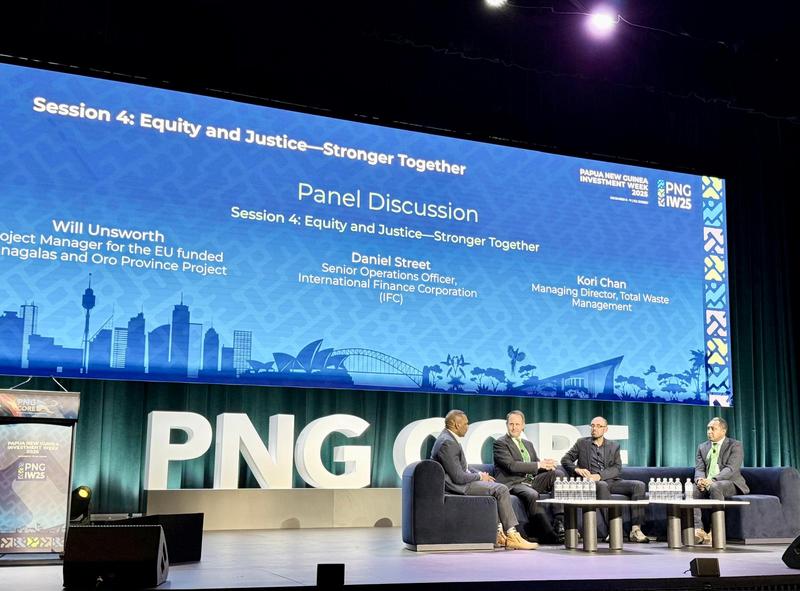
Partnerships Drive Impact
Chan acknowledged the partnerships that have enabled TWM’s growth, including customary landowners, government agencies, international development partners, and financiers.
He specifically recognized the Kuriu Clan of Roku Village, CEPA, National Planning and Monitoring, the Bank of Papua New Guinea, DFAT, USAID, JICA, and IFC. Major oil and gas developers including Santos, Kumul Petroleum, Total Energies, and especially ExxonMobil PNG provided early support, helping demonstrate that PNG capability can meet global standards.
“Our financiers, including ANZ Bank, have supported us since our 2011 start-up, and now IFC/WBG is helping accelerate TWM’s next phase of development,” Chan said.
Equity and Sustainability at the Core
Championing equity is embedded in TWM’s six core values and aligned with the United Nations Sustainable Development Goals (SDGs).
“Aligned with the principles enshrined in the UN SDGs, we aim to meet the needs of the present without compromising the ability of future generations to meet theirs,” Chan said.
Two key initiatives include a board-approved target to achieve 50/50 gender equity by 2028 and participation in the IFC-led Meri Save Trades Program.
“We are actively recruiting, promoting, and retaining women in technical, trades, and leadership positions,” Chan said. TWM’s Graduate Development Program, launched in 2016, has supported 20 graduates to date, 12 of them women, creating pathways for the next generation of environmental and technical professionals.
“An inclusive workplace is not just a moral obligation—it is a competitive advantage,” Chan said.
IFC Partnership Validates PNG Capability
Today, TWM employs more than 250 staff, with 95% national content. The IFC’s multi-million-dollar debt facility represents both capital and global validation. The partnership aligns with the Inclusive Green Finance Centre and Green Taxonomy, with leadership from the Bank of PNG in driving sustainability-focused finance.
“The IFC partnership is a timely validation of our perseverance. It is a model for high-impact investment that delivers commercial returns alongside measurable outcomes in climate resilience, social equity, and economic development,” Chan said.
Local Leadership, Global Standards
Chan described TWM’s journey as proof that local leadership aligned with global standards can deliver measurable climate, social, and economic outcomes.
“It demonstrates that companies like TWM are committed to raising the bar, setting new benchmarks for environmental stewardship, and proving that responsible business can thrive in emerging economies,” he said.
“What we’re doing at TWM is providing a way to protect our people and environment for future generations, ensuring our children inherit a cleaner, greener, and more sustainable country.”
He urged collective responsibility and decisive action.
“We are at a turning point. The decisions we make today will strengthen our socio-economic development or lead to profound challenges for future generations. With the lessons we have learned, there is no need to ask for directions. We must simply lengthen the stride and quicken the pace.”


